|
| |
Regaining The Centre
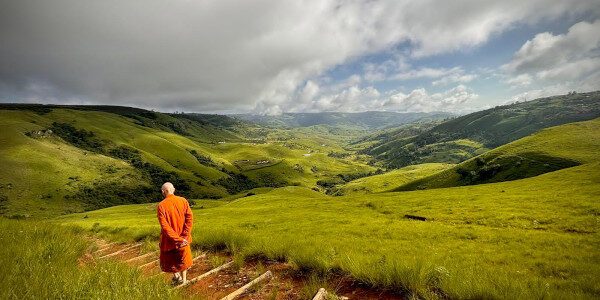
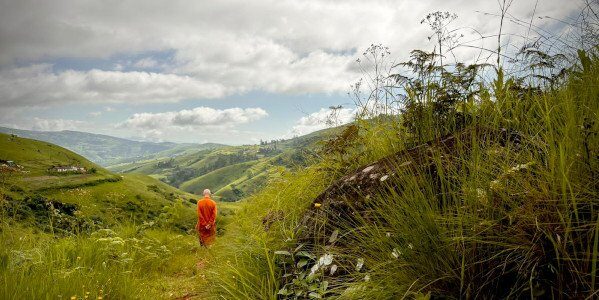
We have been so privileged to have Ajahn Sucitto, accompanied by Nick Halliday, spend a month at the Centre on sabbatical.
Over the last 38 years during which he has led retreats, his presence in Ixopo has always been a reminder of how the Dharma can settle in our lives and then radiate out to others who come to listen.
As one of the Elders of our Centre, he is very precious to us, and his return anchors me back in those early unpredictable times in a country that was so unprepared for Buddhism - as we all jumped in feet first.
Ajahn Sucitto has played such a prominent part in the history of the BRC making Buddhism so accessible - being such a seasoned scholar and teacher - so human - and such an attractive personality - a wonderful combination for making Buddhism so approachable. As Ajahn says - and - does: “Sharing Dhamma is beautiful”.
We offer Ajahn a deep bow of gratitude for his friendship to the Centre and his generosity - the myriad books he has gifted to the Centre enhance our library. Ajahn’s more recent publications “Breathing Like A Buddha” , “A Moving Balance” “ Standing On Your Own Two Feet” are available at the Centre for free distribution.
We look greatly forward to his retreat commencing on the 11 February.
With Metta,
Louis
|
|
|
|
| |
Sit Down. Breathe Meditation, Mindfulness And Compassion
Lucy Draper Clarke will be co-leading a retreat “Speak Your Truth, Listen Deeply” with Felicity Hart from 1-3 March, so I thought it appropriate to include her recent article in the “Daily Maverick”. “With the world in turmoil, it’s likely you have felt depressed or anxious – or both. But there’s an answer to the cycle of ruminating or worrying awareness, gratitude and returning to the present. Becoming conscious of the way our minds work is the gift of mindfulness, best achieved through a meditation practice. What does mindfulness mean? The original translation of the Pali word sati is “remembering” your ethics, the right way to behave in each moment. It’s shifted within the modern context and is usually translated as “being conscious and aware of the present moment”. The word I prefer to use is “awareness”. A mindful practice would be a way to bring you back to the present, to use your senses, your breath or your body as in a yoga practice. To be mindful is to be present, to be open. You are not trapped in the past or in the future. And that helps to calm you down because a lot of depression or depressive thoughts are linked to the past and things that we regret. A lot of anxiety is linked to the future. There is research on these particular tendencies. If people experience a lot of anxiety, it is often that their mind is in the future, worrying about what will happen next. The same for depression. The mind goes back to the past, ruminating cycles of things that have happened or what we have done wrong or what we perceive as wrong.
|
|
|
|
| |
The present moment frees you from those aspects. Your attention is focussed on exactly what is here and now. Within that you can bring a sense of discernment. My work is also linking it to compassion. So if the present moment is uncomfortable – experiencing a friend suffering or our own suffering – you bring compassion to that. Mindfulness and compassion go together.
How do we include meditation on our daily lives? Mindfulness is often achieved through meditation, a practice of sitting still and focussing on the breath, but we can also remain mindful throughout the day. The word “habit” is a really good one. To make your meditation as familiar a practice as brushing your teeth or having a shower. It is mental hygiene. Making it a daily practice, at a particular time of day helps people: it is less negotiable. As soon as we start negotiating with ourselves – should I practise, shouldn’t I practise – we often default to less healthy habits like scrolling the internet.
In “The Compassionate Activist” I distinguish between five categories of contemplative practices: calming, insight, positive qualities, engagement and shadow integration. The soothing practices are the ones that calm us down. For most people a deep abdominal breath can be like a switch that shifts them from chaos to calm. Moving practices also help activate and then quieten the body. When expressive movement or yoga are carried out with a real conscious awareness of the body, they can be very useful to prepare the mind for meditation. Insight practices help us gain an understanding of our own habits. If you tend to find yourself in a state of depression or anxiety, just bringing your mind back to the present again and again can shift you out of these tendencies. We often don’t believe it is as simple as that, but it is amazing how much support we can give ourselves by just coming back to the present moment.
There are also practices for cultivating positive, pro-social qualities such as curiosity, wonder, compassion, joy and gratitude which are innate aspects of being human. Training the mind to focus on gestures of care that people show us every day, even if it is being let into traffic, or someone making you a cup of tea, opens the mind to gratitude, appreciation, and wonder.
Anger is often a result of fear. We go into fight or flight mode. Hurt is the result of sadness. So we don’t need to demonise any of our difficult emotions. We use them to gather information. What am I feeling in this moment? What do I need? We learn to look at our experience rather than being swamped by it.”
|
|
|
|
| |
Conducted Retreats March 2024
☸ indicates retreats held in noble silence Felicity Joan Hart and Lucy Draper-Clarke | Weekend | 1-3 March
Learn the life-enhancing practices of mindful awareness and non-violent communication with Felicity Joan Hart and Lucy Draper-Clarke. When interacting with others, we often find ourselves triggered and then communicate in ways that hurt or harm - ourselves, the other, or the relationship between. Our conditioned ideas of what it means to communicate, especially during times of conflict, frequently results in a loss of connection. Judgement and defence, as well as the strategies of criticism, insults, blame, or put-downs are commonly used in our attempt to be heard or to meet our need to be “right,” “good” or “winning.” Despite our best efforts and intentions, we habitually become “violent” with our words and then feel the pain of disconnection. This retreat explores the principles and practices of mindfulness and non-violent communication (NVC), to foster connection and minimize the suffering of outmoded ways of engaging.
You can expect daily mindful meditation practice to support the empowering and enriching teachings of NVC, gentle exercise, and some down time for rest and relaxation.
Read more
Chamtrul Rinpoche | Weekend | 8-10 March
The mind can be like a monkey, jumping here and there - from one emotion or thought to another. In order to find peace and stability, it is useful to calm the mind by giving it something on which to focus, like the breath or sound. Once the mind has settled, it is able to be clearly aware of the truth of what is happening in the moment. This is called insight. The union of both Calm Abiding and Insight is necessary to overcome the scattered ignorance of the ordinary mind - leading to liberation. This retreat will include the explanation and practise of Calm Abiding and Insight Meditation.
Read more
Duncan Rice | 5 days | 10-15 March
Join Duncan on a loosely structured 5 day mid-week retreat which will incorporate yoga, meditation, rest, walks and reflection. The retreat is based on the ancient practices of hatha and raja yoga and is open to all levels of ability, including beginners, who wish to understand the fundamentals of yoga and develop, or deepen, their own practice. In the tranquil environment of the Buddhist Retreat Centre. We will discover how shatkarmas (cleansing techniques), asanas (postures), pranayama (control of the breath), mudra (gestures to manipulate and stimulate the energies in the body), bandhas (energy locks with the body) bring us into equilibrium. We will follow traditional guided meditation techniques in the meditation hall and in the labyrinth to quieten the mind, calm anxieties, recover balance in life and enhance creativity, insight and self-reflection. You will leave restored and rejuvenated.
Read more
Phumla Shongwe | Weekend | 15-17 March
If you feel worn out, stressed and depleted in these challenging times, then a nurturing Yin Yoga retreat is just what you need. This restorative retreat will replenish and heal you physically, mentally and emotionally. Yin yoga is a more meditative type of yoga where the postures are held while your body is supported with props, allowing you to relax, to breathe into the stretching and gravity to do its work. The slower, meditative pace gives you the opportunity to turn inwards, to breathe mindfully and to be at ease within your yourself.
Read more
|
|
|
|
| |
Albert Osel (Buhr) and Lulu Erasmus | 3 days | 21-24 March
Albert and Lulu will offer a relaxation retreat with methods to soothe and balance the nervous system, and heal the mind from excessive negative thought patterns. Counteracting the contractions of chronic stress will help participants access states of bliss, clarity, peace and kindness.
Read more
Sue Cooper | 4 or 7 days | 28 March - 1 April or 28 March - 04 April This Easter long-weekend Open the Heart and Still the Mind Compassion Retreat with clinical psychologist Sue Cooper, is held in Noble Silence and is offered either as a 4 night Easter Weekend retreat or as an extended 7 night retreat. Inspired by the wisdom teachings of the Dharma and of Buddhist and western psychology, we will cultivate mindfulness and compassion practices which calm the nervous system and help integrate body, heart and mind. As we learn to listen and connect more compassionately with ourselves, drawing silent support from the sangha (like-minded practitioners finding solace in the shared silence), we will discover that the containment of ennobling silence allows us to find the courage to honour and embody our authentic, heartfelt presence with greater confidence, clarity and joy. As we embrace the joys and the sorrows of life with a greater understanding of impermanence, we move beyond fear, shame and crippling self-doubt. This frees us from our habitual reactivity and from the curse of perfectionism. After establishing some stillness and calm in the mind and the heart, we will explore the Brahma viharas (the four divine abodes/ immeasurables) to cultivate greater kindness and compassion for ourselves and others. These compassion practices bring more appreciative joy, equanimity and wisdom into our lives, strengthening our capacity for more open-heartedness and healthier boundaries in our relationships. This silent retreat includes teachings, guided meditations, daily qigong, time to walk, rest and replenish, as well as short, individual sessions with Sue to deepen our insight and sense of well-being. There will be relaxing massages and mindful movement offered as optional extras (the cost of which to be confirmed), to support our embodied experience. Please note: There is a teacher's fee for this retreat, which is offered on a sliding scale, with reductions and payment plans on request. A pre-retreat individual session via Zoom/Whatsapp is required for newcomers or if you have not attended one of Sue’s residential retreats before. The fee for this will be the 50-55 minute medical aid rate and will be reduced if necessary. Please contact Sue on to arrange a time and for the course fee. CPD accreditation for health and mental-health professionals will be confirmed, at an additional admin fee of R375.
Read more
Think peace over pressure and serenity over stress. Enjoy some time at the BRC mid-week, with nourishing vegetarian meals, sunrise meditation and nature's healing embrace to colour the mood of your day. There is no better place than the BRC to rejuvenate the body and mind to guide you into presence and stillness.
Read more
|
|
|
|
| |
For Bookings, send an email to bookings@brcixopo.co.za
Please use this link to view the photos of the various types of accommodation |
|
|